TELLURIDE,
COLORADO |
In
speaking of miners, labor historian
Mark
Leier, said, "These lives may have been raw, but it's important to know
their sweat, blood, and dreams if we are to know all of our history. They
fought to make our lives better and their example can be an inspiration for the
issues we face."
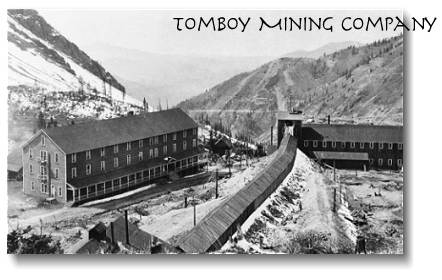
Colorado's San Miguel County
Commissioner, Art Goodtimes, conceived the idea of a Telluride Miners' Memorial
in fall 2004. Because Telluride owed her existence to miners, yet had a dark
time in her history when several mine owners, her leading citizens, and their
hired gunmen illegally and brutally drove union miners, their families, and
supporters from the town, Goodtimes believes such a memorial will heal the
shadows of 100 years ago. The life-size bronze, featuring Vincent St. John, Telluride's own unsung hero, will
restore the miners to their rightful place in this mountain town's history,
acknowledging their many contributions, honoring their sacrifices and
heartaches, commemorating those who died in the great Bullion Tunnel fire and
other local disasters, and celebrating the miners' boisterous camaraderie.
The Telluride Miners' Memorial is being
designed and created by Telluride sculptor, Richard Arnold. The work is being funded through
contributions from local and national donors. If you have a love for, or a
connection to Telluride, her mining history, or her miners, please join us, the
Telluride Historical Museum, the
Telluride Watch, the
Wilkinson Library,
Writers in the
Sky, publishers, architects, teachers, students, and the enthusiastic
Telluride citizens in making this work a reality.
Richard Arnold's challenge is to
recreate in bronze Vincent St. John holding the limp body of a fellow miner who
has succumbed in the Bullion fire, illustrating both
the difficult and dangerous profession of the miner as well as capturing the
miners' absolute dependence on one another and their instinctual protection of
their fellow worker.
This page will keep you updated as the
work progresses.

VINCENT ST. JOHN:
Honoring a Real American Labor Hero
by Art
Goodtimes
|
Why a statue for Vincent St. John?
Blame it on
a book.
MaryJoy Martin's The Corpse of Boomerang Road (Western
Reflections, Montrose, 2004) is an historical blockbuster. It explodes the
myths and legends that for too long have passed for history in Telluride.
Against a backdrop of high peaks and deceitful behavior, good guys and bad guys
change places. This is revisionist fireworks at their take-you-by-surprise
best.
It wasn't but a handful of years ago that a bad play premiered
locally trying to portray Bulkeley Wells as a charming if difficult man. Pop!
Bang! Wrong! He was a dastardly villain who twisted the truth, staged the
bombing of his own bedroom, and repeatedly used every means at his disposal to
discredit a union intent on equal pay and an eight-hour-day.
Official
history tags the Western Federation of Miners as bombers and assassins,
disposed towards violent means at every turn. Zoom! Zam! Kaboom! PR fiction
(paid for by the mine owners), as the Union mostly responded to violence
inflicted on it by the vigilante mobs and the National Guard.
Martin
digs deeper than the mere chronicle of a town's dissolution and self-destruct
as a labor/capital battleground. She makes stories come alive, until you can
almost hear the rattle of General Sherman Bell's Gatling gun splintering aspen
in an intimidating show of anti-labor force. She rattles the skeletons in a lot
of closets.
This is a far cry from the Town Without A Bellyache, as
Telluride was once known in the prosperous 1880s and 1890s, when the mills were
roaring and the populace riding the crest of a heavy metal boom. The turn of
the 19th Century was a traumatic event for the nation. McKinley assassinated by
an anarchist. Manifest Destiny leading us into war in the Philippines. And all
the ills inherent in the laissez faire American capitalist system getting
played out on Colorado Avenue, and in the surrounding hills. The town's largest
mine and mill, the Smuggler-Union, got bought up from sympathetic management
with Nate Mansfield at the helm (universally liked as a kind and generous
manager) and turned over to corporate henchmen - back when the Bostonian
Livermores acquired the property for $3 million (a hundred years ago), and
tried to squeeze out profits at the expense of their workers. It was
unregulated capitalism's ugliest face.
Martin clearly takes sides in
this struggle. Thanks to meticulous and exhaustive research, she solves the
mystery. There was no corpse on Boomerang Road - a fiction dreamed up by Wells
and company. And the reader soon realizes that the heroic young labor leader,
Vincent St. John, was up against a coordinated effort on the part of the
business classes to sleight, insult, slander, bully, provoke to violence and
physically destroy the Miners' Union, not only in Telluride, but all across the
West. Kentucky-born St. John, who quickly rose from young miner supporting a
widowed mom and sister to leader of the local chapter of the Western Federation
of Miners, would eventually be run out of town. And he would go on to become a
founding member and general secretary of the International Workers of the World
(IWW, aka the Wobblies), who are celebrating their 100th anniversary this year.
But, we're getting ahead of ourselves.
Telluride was one of the
decisive battles in the war between labor and capital. Here labor lost. Not
because the union men were violent. Reliable accounts seem to suggest they were
just the opposite - visionaries intent on achieving their goals of an
eight-hour work day, decent wages ($3 a day back then) and safe working
conditions for all. By peaceful and legal means. Violence was a tool of the
mine owners. Though the union was branded with its stigma.
In the hands
of the vindictive Eddie Curry and in collusion with one of the town's veteran
bankers, A. M. Wrench, the town's daily newspaper spewed lies for so many years
that history has been colored with its opprobrium. Local and state politicians
of the day used every trick of the trade to break the union (including martial
law). The mine owners hired thugs and scabs. And businessmen condoned mob rule,
railroading union sympathizers out of town, often at gunpoint. In the end,
union miners were beaten, blackballed, killed, or banished, most never to
return. It's a very disturbing legacy that most Telluridians have been
completely ignorant about. Or simply chose not to ever discuss publicly.
In her book, Martin traces what happened to St. John – one of the
most inspiring figures that ever walked Colorado Avenue. And what happened to
Wells, the Harvard dandy who lied, cheated, and paid the notorious Pinkertons
to fabricate evidence, build phony cases, and even kidnap union leaders for
trumped-up grand juries. When Wells puts a bullet through his bankrupt head in
a San Francisco office building, one almost wants to applaud. As if this
arrogant reprobate finally got what he deserved – after ruining the lives
of so many innocent workers and turning a vibrant mountain community into a law
and order company town.
The last scene of the book is St. John's
deathbed, and the contrast with Wells is striking. A man who gave so much of
his life for others, braving bullets and fire, persecuted endlessly, serving
jail time unjustly, St. John ends up bankrupt as well. But instead of taking
his own life, he is taken in by friends, celebrated by many, a hero of the
working class – his memory is an American flame on the altar of social
justice.
Telluride needs to honor this man. Somehow. Some way.
That was my initial reaction to reading Martin's book in the fall of
last year. I wanted a memorial to this real American hero. And since then,
Martin and local sculptor Richard Arnold, along with Telluride Watch
publisher Seth Cagin and local designer and history buff George Greenbank, have
joined me in calling for a miner's memorial to Vincent St. John.
We
have formed a little committee. If you are interested in helping us in any way,
please contact us.
|
A
FEW WORDS FROM GEORGE GREENBANK, Committee Member
As a young
architect graduated from the University of Colorado, I moved to Telluride in
the spring of 1971. An historic Telluride building owned by Louise Gerdts had
been used as a senior project and I had researched information on the building
in the archives deep below Norlin Library at CU Boulder.
Having been
politicized by the Vietnam War and current events, I was excited and appalled
by the glimpse the library's records provided into Telluride's past. The story
of Vincent St. John and Telluride's Western Federation of Miner's Union was
especially exciting, but the archives offered only a limited view.
Upon
arriving in Telluride, I visited my great aunt Edith Rucker, Alta Cassietto,
and other old timers. My question about Vincent St. John and the turn of
century events surrounding the Miners Union were not fully answered. Often the
subject was diverted to more contemporary discussions on the railroad, early
attempts at establishing skiing, or the highly charged issue of Wilderness
designation. Sometimes, when I persisted, it was suggested that Telluride's
role in the Union troubles was not a “proud” part of local history
and other topics were best explored, as “family still existed” that
might not appreciate my inquisitive meddling.
As the years passed I,
too, placed my original excitement about the 16 to 1 Miner's Union on the back
shelf.
In the 1980s, my brother suggested that I read “Where
the West Stayed Young,” by Charles Russell, a book about northwest
Colorado and the range cattle business. It was about the involvement of big
money, English investors in the cattle business, and the confrontations with
small homesteaders and ranchers in the Brown's Park area. The big investment
cattle companies hired gunmen and private police to intimidate and sometimes
kill those who stood in the way of their land-use practices and economic goals.
I again was excited by the period of history from the late 1800s to early
1900s. The oppression of small farmers and ranchers and the invasion of their
civil rights by investor interests became a theme I looked for in my history
reading.
Bob Meldrum's name appeared in a story within this ranching
book. As the town marshal, Bob had killed a young popular cowboy on the streets
of Baggs, Wyoming. Meldrum's work in Telluride for the mine owners and the town
of Telluride was briefly mentioned.
A town marshal who matched the
spirit, if not the gunmanship, of Bob Meldrum, had greeted many of us young,
usually longhaired, residents of Telluride in the early 1970s. Marshal Everett
Morrow's attitude towards us, and incidents created by him, became a focus of
the emerging new Telluride population. Our complaints to Town Council were
simply ignored. This resulted in the formation of a “slate” of new
residents running for Town Council in 1974. I was one of those elected and of
course our first act as a new council was firing Marshal Everett. The
civil rights of citizens of Telluride were protected.
When MaryJoy
Martin's book on the Telluride Miner's Union and Vincent St. John first caught
my attention, I went straight to the excellent index and there was Bob Meldrum.
Bob's tenure as Deputy Town Marshal during the union era seemed to have created
a pattern and attitude toward the citizens that the Town had trouble not
repeating.
I rediscovered the incredible story of the WFM, Telluride's
16 to1 Union, and the amazing Vincent St. John that had first excited me back
in 1970-71.
I realized that Telluride had lost a significant part of
its history. Respect for local living families, whose patriarchs had performed
so badly during the labor difficulties at the turn-of-the-century, had resulted
in the community's and, especially the town and county governments', failure to
confront and atone for their complicity in the denial of union miners their
human rights when the WFM was run out of Telluride.
As “The
Corpse on Boomerang Road” so well describes, the “spirit of
Telluride” was broken when the community and the government, which had
first supported the noble cause of the unions, “drove them from our
midst” with the help of deputized killers and fabricated lies.
The
demonstration of community cohesiveness, once represented by the construction
of the Miner's Union Hospital (still one of Telluride's finest buildings), was
pushed aside, as the mine owners association, popular Bulkeley Wells, and the
town and county governments stripped the union miners of their rights as
citizens and deported them to Ridgway and Montrose.
A subtle animosity
has always seemed to affect relations between Telluride and Montrose. MaryJoy's
book describes the soup kitchen and rooming house, which served deported
Telluride union miners in that town. I imagine that many of these people found
jobs and homes in the Montrose community. Resentment towards the Telluride
community would be understandable and continue for generations.
I would
hope that the Telluride community and governments would now begin a process of
healing fostered by a new and better understanding of that history.
George Greenbank
Telluride, 2005
|
Copyright by TMM 2005 |
  |