THE
MEMORIAL |
 |
 |
The young man who, as
president of Telluride's WFM Local 63, led the miners to victory in 1901,
gaining the everlasting enmity of the mining corporations, was the son of an
Irish immigrant, Marian "Mary" Cecilia Magee, and New York native, Silas St.
John. Vincent was born in Newport, Kentucky, 6 July 1876. He was the couple's
first surviving son, following on the deaths of their first three children.
Vincent had a sister two years younger named Helen and one seven years younger
named Mary. The family moved frequently, eventually settling in San Jose,
California.
Vincent grew up working
hard to supplement the family's income, dropping out of school at thirteen to
support his deserted mother and sisters (Silas no longer acknowledged his
children). At seventeen, Vincent found work as a miner, a profession that led
him into the arms of the Western Federation of Miners (WFM). At eighteen he
found work in the Cripple Creek mines. At twenty he moved to Telluride and was
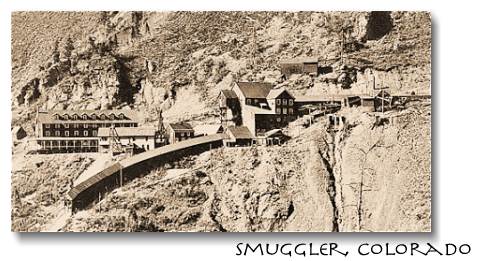
hired at the Smuggler-Union in early 1897. With nearly a hundred other miners,
he lived near the Bullion Tunnel in a drafty bunkhouse. His free hours were
spent with books, music, chess, and camaraderie. His fellow miners loved him.
His deep sense of purpose, passion for justice, and unflagging energy were
contagious to them. They were captivated by his naïve idealism and the
Irish wit and sarcasm inherited from his mother, now honed to an art form.
|

St. John spoke to
the hearts of young and old alike. He believed in political action and direct
action to bring labor out of the pit of wage slavery, but abhorred violence,
always stressing the principles of the WFM constitution, "to use all honorable
means to maintain and promote friendly relations between ourselves and our
employers." His oft-repeated line was, "Violence never solves anything."
The baby-faced, twenty-four-year-old Vincent St. John was elected as
president of Telluride Local 63 in September 1900. His comrades affectionately
called him "Vint" or "Saint"– the latter nickname having nothing to do
with piety or Vatican proclamations, but merely derived from his surname. His
leadership was put to the test in early 1901 when the new manager of the
Smuggler-Union Mining Company cut the wages of most of the company's miners.
Local 63 unanimously voted to strike.
|
Despite harassment and
mounting tension, St. John kept the striking miners peaceful, urging them on to
see the strike through. When hired gunmen shot an unarmed striker, a riot
erupted in Marshall Basin, where pickets were posted. St. John almost
single-handedly brought the riot to an end within a few hours, and finally
brought the strike to a successful conclusion. The mine manager signed an
agreement with the union to restore living wages and other demands.
The majority of
Telluride's citizens viewed St. John's efforts as heroic and he was held in
high regard by miners and townsfolk alike. He was nominated to run for sheriff
in the fall of 1901, losing by only 36 votes. A handful of local businessmen
and the Smuggler-Union Company ran an ugly campaign to discredit and vilify St.
John before the election, but after his selfless work to save his comrades and
to recover their bodies during the nightmare fire of 20 November 1901, at the
Smuggler, this group set out to destroy the man. They didn't fear St. John as a
man; they feared his power to unite large bodies of laboring
men.
|
And unite them, he did.
Union membership swelled to 1,300, the largest in the state. Reelected time and
again as president of the local union and the San Juan District Union, St. John
ignored the bitter and threatening clique, dedicating himself to improving the
lot of his fellow miners. He organized a reading room, insisted that union
literature be in several languages to reach the numerous immigrant miners, and
inspired the membership to strive for great things, such as the construction of
a three-story brick hospital that would house also a library and union offices.
|
 |
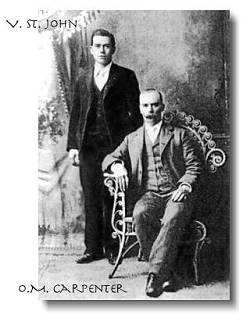
Along with his best friend
and fellow union officer, Secretary/Treasurer Oscar M. Carpenter, St. John
motivated the membership to donate funds for the project, a project that was
met with enthusiasm throughout the district. Businessmen donated funds and
equipment and in November of 1902 the Telluride Miners' Union Hospital opened
its doors. It was an astounding achievement, and is one of the finest original
buildings still standing in Telluride, a mute reminder of the solidarity of a
once vibrant union.
|
St. John and Carpenter
were hailed as champions, thus becoming targets of an unceasing persecution. A
hired gunman was sent after St. John and he never could safely return to
Telluride. During the millmen strike in 1903-04 for an eight-hour day and
nondiscrimination, Oscar Carpenter was also brutally run out of town. The two
were accused of murdering Will Barney and condemned by the anti-labor press for
butchering this one-time Smuggler Mine guard. Documents since have proven
Barney was never murdered; he was quite alive a year and eight years after his
date with death. |
 |
Vincent St. John went on
to organize the miners in Utah, Nevada, and Idaho. Wherever he went he was
persecuted, arrested on false charges, incarcerated without due process and
eventually let out if he promised to leave town. In November 1907 Paddy
Mullaney attempted to assassinate him on the streets of Goldfield, Nevada. The
bullets shattered his bones, permanently crippling his right arm. Mullaney was
never charged.
In 1907, St. John was
elected as General Secretary of the Industrial
Workers of the World. He served in this capacity until 1914, when he
retired to a small mining claim in New Mexico. He worked the claim with his old
friend, Oscar Carpenter, but was again arrested on trumped-up charges, this
time by the federal government. Hundreds of members of the Industrial Workers
of the World were charged under blanket indictments that produced blanket
convictions. Today the government admits these men and women were political
prisoners. The sweep was meant to destroy what had become one of the most
powerful unions in the country. |
St. John served thirteen
months of a 10-year sentence that was designed to leave him a broken old man.
On 23 June 1923, President Warren G. Harding signed a document stating,
"Vincent St. John is a fit object of executive clemency," and the Saint walked
free.
Due to his arrest and time fighting his unjust indictment, appeal
and incarceration, St. John had lost his small claim in New Mexico and came out
of Leavenworth impoverished. His health was shattered by tuberculosis
contracted in prison and he died only six years later on 21 June 1929, at the
age of 52. He was buried in Oakland, California's Mountain View Cemetery,
without a stone to mark his passing. In 1992 a group of Bay Area labor
activists were granted permission to place a memorial at The Saint's final
resting place. The simple red-granite stone honors his life-long commitment to
the cause of labor. |
 |
To read the story of Vincent St.
John and Oscar M.Carpenter
in the context of Telluride's labor history, see
the book
The
Corpse on Boomerang Road: Telluride's War on Labor
1899-1908
Copyright by TMM 2005
[From the book, The Corpse
on Boomerang Road: Telluride's War on Labor 1899-1908, Western Reflections
Publishing 2004. No part of this material may be used without permission of
TMM] |
 
"Let truth light our
way" |